Actuel vs Actual: French False Friend
French actuel means current, not actual. Learn when to use actuel, réel, véritable, and en fait through natural contrastive examples.
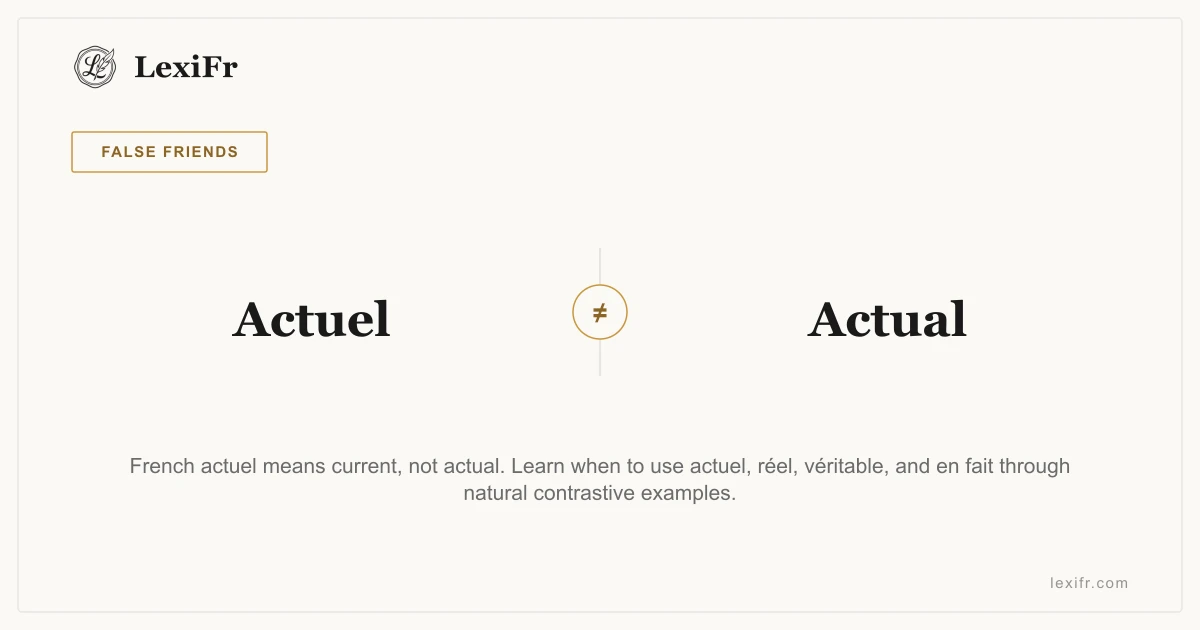
Actuel looks so transparent that English speakers often accept the wrong meaning without noticing. In French, it locates something in the present: the current situation, the present owner, today’s rules. English actual usually insists on reality or corrects an assumption. French handles that second idea with réel, véritable, exact, or a phrase such as en fait.
Quick answer
French actuel means “current” or “present-day.” To express English “actual,” choose réel, véritable, exact, or en fait according to the sentence.
Quick answer: what actuel really describes
Actuel is an adjective connected to the present time. It agrees normally: actuel, actuelle, actuels, actuelles. It can describe a job, address, government, price, problem, or stage of a process. It does not certify that something is real. The related noun actualité means current events or a current issue, and les actualités means the news. That family connection reinforces the time meaning. It does not turn actualité into English “actuality,” which usually concerns reality and may require réalité in French.
Mon adresse actuelle est à Lyon. → My current address is in Lyon.
La situation actuelle reste fragile. → The current situation remains fragile.
Ses collègues actuels travaillent à distance. → His current colleagues work remotely.
Why English actual needs several French choices
English “actual” can contrast reality with appearance, correct a figure, or identify the thing itself. French chooses a word for that precise function. Réel concerns reality, véritable often stresses authenticity, exact concerns accuracy, and en fait introduces a correction at sentence level. Courant can sometimes replace actuel for something in ordinary present use, while contemporain connects something to the same period or to the present era. Le langage courant means everyday usage; un auteur contemporain means a contemporary author. These neighbours show why one broad English adjective should not force one French answer.
Le coût réel dépasse le devis. → The actual cost exceeds the estimate.
C’est un véritable problème. → It is an actual/genuine problem.
Quel est le montant exact ? → What is the actual/exact amount?
En fait, le train part demain. → Actually, the train leaves tomorrow.
Wrong vs right examples: the contrast in sentences
Compare the time meaning with the reality meaning. The noun may remain the same while the adjective changes the question being answered: “Which one applies now?” versus “What is it really?”
Translate the intended function, not the English lookalike
| English intention | Natural French choice | French example | Reason |
|---|---|---|---|
| current schedule | actuel | L’horaire actuel reste provisoire. | Actuel places the schedule in the present. |
| actual final cost | coût réel | Le coût réel inclut la livraison. | Réel contrasts the final cost with an estimate. |
| actual measurements | mesures exactes | Voici les mesures exactes de la pièce. | Exactes stresses numerical accuracy. |
| a genuine improvement | une véritable amélioration | Ce changement est une véritable amélioration. | Véritable stresses authenticity or full force. |
| actually, the meeting is Friday | en fait | En fait, la réunion aura lieu vendredi. | En fait corrects the preceding assumption. |
Le directeur actuel arrive à huit heures. → The current director arrives at eight.
Le véritable directeur n’apparaît pas dans la scène. → The actual/real director does not appear in the scene.
Le prix actuel est de cinquante euros. → The current price is fifty euros.
Le prix réel, avec les frais, est de soixante euros. → The actual price, including fees, is sixty euros.
Actually is rarely actuellement
Actuellement means “currently” or “at present.” It is another member of the same time family. To correct someone with English “actually,” use en fait most often, or phrases such as à vrai dire depending on tone. Presently can be ambiguous in English, so translate the intended meaning rather than the surface form.
Je travaille actuellement à Marseille. → I am currently working in Marseille.
En fait, je travaille à Nice. → Actually, I work in Nice.
À vrai dire, je ne suis pas convaincu. → To tell the truth, I am not convinced.
False-friend mistakes in context
Do not write le coût actuel when you mean the final real cost; that phrase means the cost at the present time. Do not use actuellement as a conversational correction. Conversely, réel is not a general substitute for actuel: un problème réel is genuine, while un problème actuel belongs to the present period.
C’est un débat actuel. → It is a current/contemporary debate.
C’est un débat réel. → It is a real debate, not an invented one.
A memory tip: actuel lives on a timeline
Attach actuel to aujourd’hui. If “today’s/current” fits, the French adjective is plausible. If the English sentence contrasts fact with appearance or estimates, step away from actuel and ask whether you need réel, véritable, exact, or en fait. A timeline and a truth test are different tools: actuel answers “when does this apply?”, while the alternatives answer “what is really or precisely the case?” This distinction also prevents actuellement from slipping into corrections where en fait belongs.
Practice choosing the function before the word
Translate by identifying the function first. “Our current office” points to the office used now. “The actual size” corrects an estimate and calls for taille réelle or exacte. “Actually, I disagree” corrects the conversation and begins naturally with en fait.
Notre bureau actuel est trop petit. → Our current office is too small.
La taille réelle est indiquée au dos. → The actual size is shown on the back.
En fait, je ne suis pas d’accord. → Actually, I disagree.
Questions about the false friend
These distinctions cover the adverb actuellement and the overlap between réel and véritable without pretending that English has one fixed French equivalent. Read the whole clause before choosing: correction, authenticity, precision, and present time lead to different French forms.
Related reading
Don't let the English decoy win.
LexiFr drills this false friend in real sentences, resurfacing it days apart, so the tempting wrong translation loses its pull.
Free to start - no ads, no streak guilt. Your first 200 words are waiting.
Questions about this note
Does actuel ever mean “actual”?
Only when English “actual” itself means current, which is uncommon. The reliable French meaning is current or present-day.
What is the difference between réel and véritable?
Both can express reality. Réel contrasts with imaginary or apparent; véritable often stresses authenticity or the full force of a description.
Does actuellement mean “actually”?
No. Actuellement means currently. En fait is the usual conversational equivalent of “actually” when correcting an idea.
How do I say “the actual number”?
Le nombre exact is natural when accuracy matters; le nombre réel can contrast the real figure with an estimate or claim.